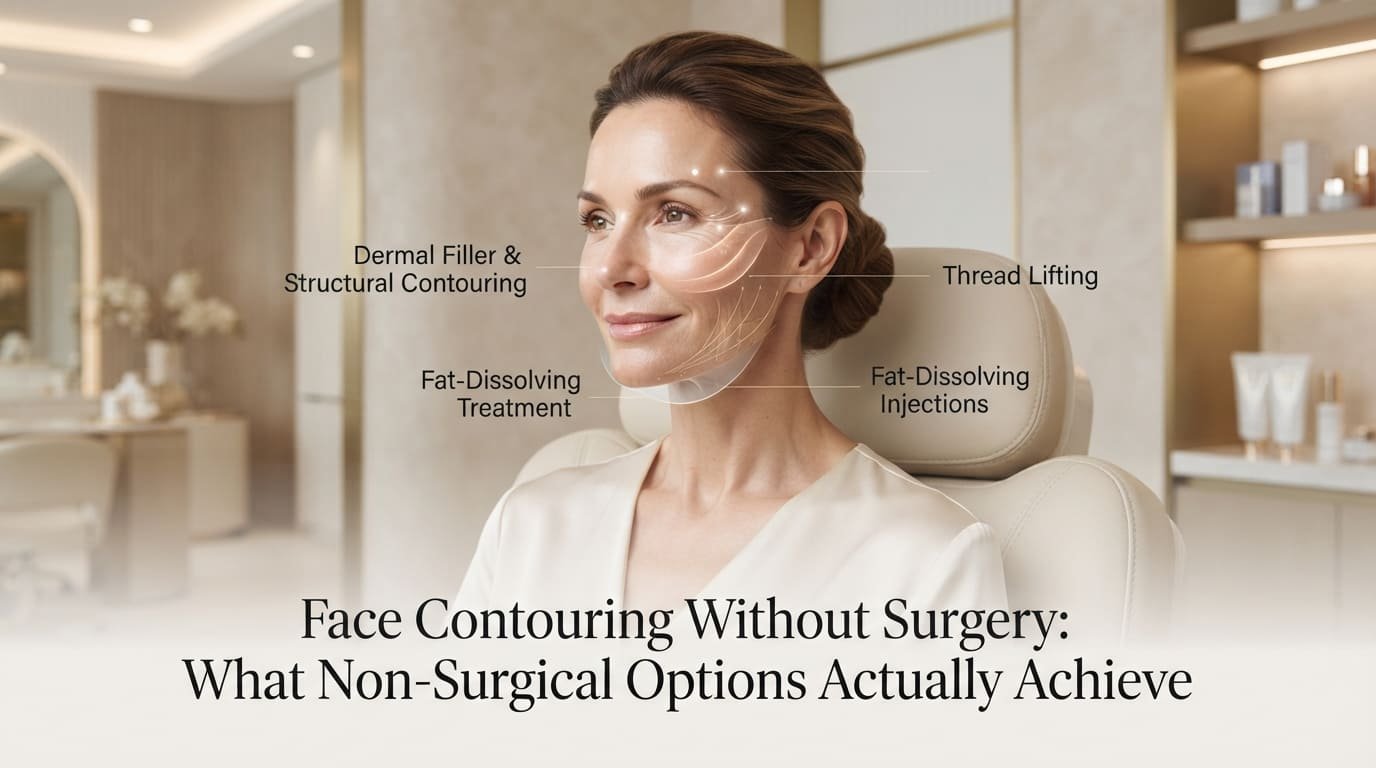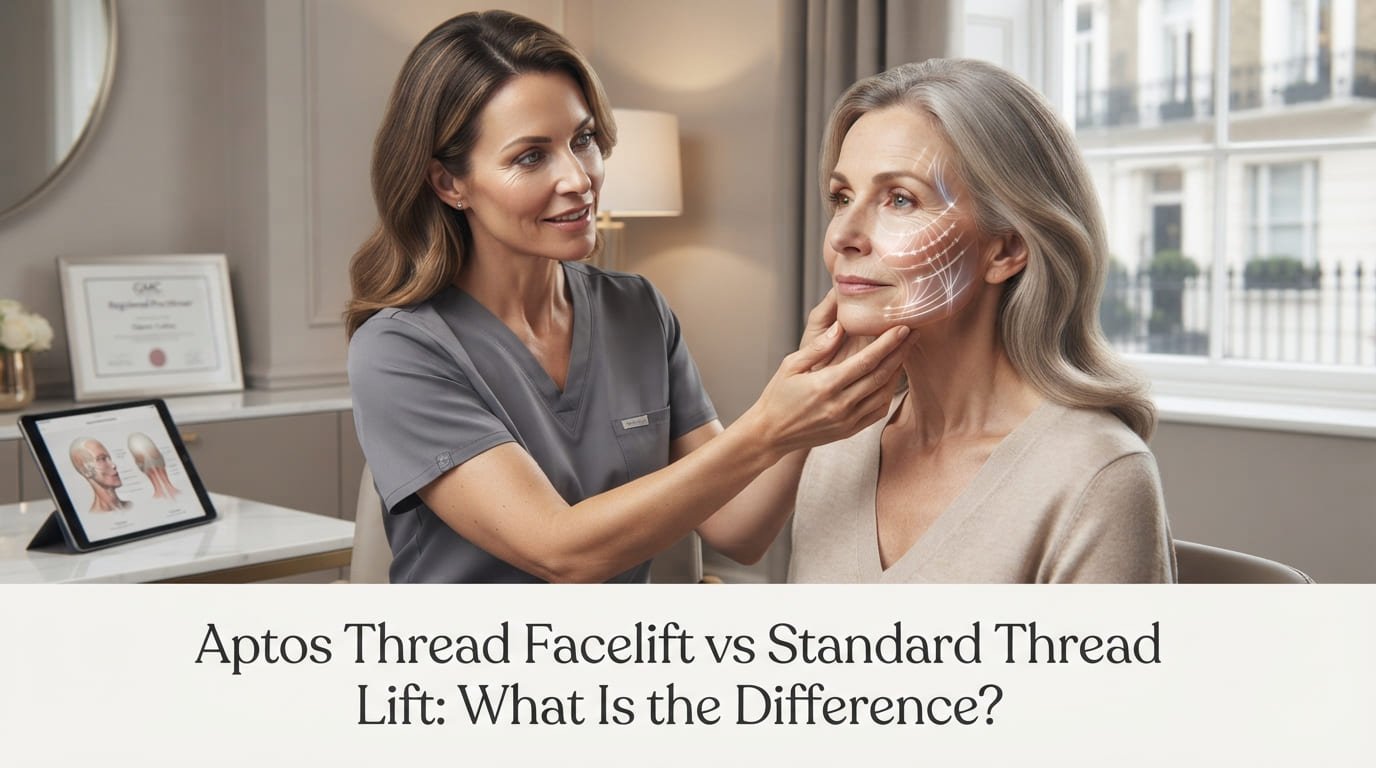
Thread lifting has established itself as one of the most effective non-surgical approaches to facial rejuvenation available in aesthetic medicine. The concept is compelling. Fine threads inserted beneath the skin provide an immediate mechanical lift of descended tissue, and then as the threads dissolve, they stimulate collagen production that sustains the result long after the physical threads themselves are gone.
What most patients researching thread lifts do not realise is that threads are not all the same thing. The material they are made from, the design of their surface, and how they interact with the tissue over time produce meaningfully different clinical outcomes. Understanding the specific difference between Aptos threads and standard PDO threads is what separates a patient who makes an informed treatment decision from one who simply books the nearest available thread lift without knowing what they are actually getting.
What Standard PDO Thread Lifts Are
PDO stands for polydioxanone. It is a synthetic polymer that has been used in surgical sutures for decades. Its history in medicine is long, and its biocompatibility is well established. It was the first thread material to be widely adopted in aesthetic thread lifting practice, which is why PDO threads remain the most familiar thread category to most patients who have done any research.
PDO threads work through two mechanisms. The first is mechanical. Once inserted and positioned beneath the skin, barbed or cog threads grab the surrounding tissue and allow the practitioner to physically reposition descended soft tissue upward and hold it there. The lift is visible immediately after treatment. The second mechanism is biological. As polydioxanone dissolves in the tissue, which typically occurs over a period of six to nine months, the body mounts a mild inflammatory response to the dissolving material. That response stimulates fibroblast activity and collagen production in the surrounding tissue, which contributes to sustained skin quality improvement after the mechanical lift has gone.
Standard PDO threads have served patients well and have a substantial clinical track record. For many patients with mild to moderate facial laxity, a well-placed PDO thread lift produces a genuinely satisfying and natural-looking result. The limitation of PDO threads is primarily related to how long the mechanical effect lasts and the degree of collagen stimulation they drive relative to more advanced thread materials.
Because PDO dissolves relatively quickly at six to nine months, the mechanical lifting effect is time-limited. The collagen that forms in response to the dissolving threads continues to provide some benefit beyond this point, but the structural lift diminishes as the physical material is absorbed. Most patients find the primary visible result from PDO threads is most evident in the first six months and then gradually softens over the following six to twelve months as the residual collagen effect sustains but does not replace the mechanical element.
What Makes Aptos Threads Different
Aptos threads were developed through the work of Dr Marlen Sulamanidze in Georgia, who pioneered the concept of thread lifting in the 1990s and continued to develop the technology through the decades that followed. The Aptos company has invested significantly in thread design research, which has produced a product that differs from standard PDO threads in several clinically meaningful ways.
The first distinction is material. Aptos threads in their current most advanced formulation use a combination of polycaprolactone and polylactic acid, which together produce a thread that dissolves significantly more slowly than polydioxanone. Where PDO dissolves over six to nine months, Aptos threads in their standard configuration last 18 to 24 months before full absorption. This extended presence in the tissue has two direct clinical consequences. The mechanical lifting effect is sustained for considerably longer. The collagen stimulation response, which occurs progressively throughout the period of dissolution, continues over a longer timeframe and produces more cumulative collagen than a faster-dissolving PDO thread does.
The second distinction is the barb design. Aptos threads feature multidirectional barbs positioned strategically along their length. The specific geometry of these barbs is engineered to provide a more secure grip on the surrounding tissue than the simpler barb configurations found on many standard PDO threads. This enhanced anchoring means the tissue is repositioned more precisely, held more securely, and maintained in the corrected position more reliably as the tissue settles in the weeks following treatment.
The third distinction is unique to Aptos in the entire global thread market and represents a genuine innovation rather than an incremental engineering improvement. Aptos threads are coated with hyaluronic acid. No other thread manufacturer currently offers this. The hyaluronic acid coating serves several functions simultaneously. It lubricates the thread during insertion, which reduces the mechanical trauma to the tissue as the thread is passed through it. It provides immediate local hydration in the tissue surrounding the thread. And it contributes to the biological environment around the thread in a way that supports both the healing response and the collagen stimulation that follows insertion.
This hyaluronic acid coating means Aptos threads are not simply a mechanical lifting device in the way that simpler threads are. They are delivering an active regenerative component alongside the structural lift, which produces a qualitatively different biological environment in the treated tissue compared to threads that provide only mechanical support and dissolve without any additional active ingredient.
How the Treatment Experience Differs
From the patient's perspective, the treatment experience of an Aptos thread lift and a standard PDO thread lift is broadly similar. Both are performed under local anaesthetic. Both involve fine needles or cannulas passed through small entry points in the skin to position the threads in the correct tissue plane. Both result in an immediate visible lift that is evident from the appointment.
The recovery experience is comparable between the two. Some swelling and bruising in the days following treatment is expected with both. Most patients feel comfortable resuming normal daily activities within a few days, though visible bruising and tightness may persist for up to ten days depending on the individual.
One difference in the treatment experience worth noting is that the multidirectional barb design of Aptos threads provides a slightly different tactile sensation during the positioning phase of the procedure compared to simpler PDO threads. This is a very minor distinction in the treatment experience itself and not something most patients find significant. What matters more is the skill and experience of the practitioner placing the threads, which determines the quality of the result far more than the specific thread design does.
The number of threads used in an Aptos facelift treatment versus a standard PDO lift varies depending on the clinical presentation, the areas being treated, and the practitioner's protocol. A thorough consultation will establish what is appropriate for your specific face before any treatment is planned.
Who Aptos Thread Facelift Is Most Appropriate For
The extended longevity, stronger tissue anchoring, and hyaluronic acid component of Aptos threads make them particularly well suited to certain patient presentations where the clinical advantage over standard PDO threads is most meaningful.
Patients with moderate to more significant soft tissue descent where a more secure and longer-lasting lift is the priority benefit most clearly from the Aptos multidirectional barb design and slower dissolution timeline. A patient whose jowling or midface descent is at the more significant end of what non-surgical treatment can address needs the most capable thread available, and Aptos threads are at the top of that clinical range.
Patients who want the longest possible duration between treatments and who prefer to invest in a higher-quality result that holds for two years rather than returning for repeat PDO treatment after twelve months are better served by the Aptos timeline.
Patients who want a thread treatment that delivers more than a mechanical lift benefit from the biological component provided by the HA coating. The hydration and collagen-stimulating environment created by the HA-coated threads produces a skin quality improvement alongside the structural lift that standard PDO threads do not replicate.
Patients who have previously had PDO thread lifts and found the duration of the result shorter than they wanted, or who feel the lift was less defined than they hoped, often respond well to transitioning to Aptos threads for subsequent treatments.
When Standard PDO Threads Remain an Appropriate Choice
Aptos threads are not the right choice for every patient presenting for a thread lift consultation, and understanding where standard PDO threads remain appropriate is part of giving a complete clinical picture.
Patients with mild laxity who have not previously had thread treatment often benefit from starting with a standard PDO lift. The result is meaningful, the procedure is well tolerated, and the clinical risk associated with any first thread treatment can be assessed before committing to the longer-lasting Aptos option.
Patients where the primary goal is collagen stimulation rather than mechanical lift, and where a more straightforward dissolving thread is appropriate for the treatment area and depth, may be equally well served by standard PDO threads depending on the specific presentation.
Cost is also a real clinical consideration. Aptos threads are priced higher than standard PDO threads, reflecting the material quality, the research investment behind the product, and the longer clinical lifespan. For patients where budget constrains the treatment programme, a well-placed PDO lift delivers genuine value and should not be dismissed as inferior simply because more advanced options exist. The right thread for any patient is the one that best matches their clinical need, their expectations, and the full context of their situation.
Combining Thread Lifting With Other Treatments
Thread lifting in either form produces its most complete result when placed within a broader treatment programme rather than used as an isolated intervention. The structural lift addresses soft tissue descent. The surrounding tissue quality, skin hydration, and collagen density all benefit from complementary treatments used alongside threads.
Polynucleotides used in the months around a thread lift support the tissue regeneration environment in a way that complements the collagen stimulation the threads initiate. Profhilo or skin booster treatments improve the hydration and structural quality of the skin above the lifted tissue. Anti-wrinkle injections address the dynamic muscle activity that continues to crease the skin surface regardless of how well the underlying tissue has been repositioned.
Radiesse in its hyperdilute form is increasingly used alongside thread lifting for patients where broader skin quality regeneration in the neck and lower face is part of the treatment goal alongside the structural lift.
The combination of Aptos threads, with their HA coating and extended collagen stimulation timeline, with polynucleotide treatment is particularly logical because both work on the regenerative biology of the tissue over an extended period. The cumulative effect of both mechanisms working simultaneously produces a result that outlasts either treatment alone.
What a Good Consultation for Thread Lifting Should Establish
The outcome of a thread lift is more dependent on the quality of the consultation that precedes it than on the choice of thread alone. A consultation for thread lifting should assess the degree of soft tissue descent across all relevant facial zones, the skin quality and elasticity of the tissue being lifted, the realistic outcome achievable given the current presentation, and whether a thread lift alone is appropriate or whether combination treatment produces a better result.
It should also involve an honest conversation about what thread lifting cannot achieve. Significant soft tissue descent with markedly reduced skin elasticity is better served by surgical consultation. A practitioner who recommends thread lifting for every patient presenting with laxity, regardless of severity, is not serving those patients well.
The right recommendation is the one that honestly reflects what is achievable for your specific face. Sometimes that is Aptos threads. Sometimes it is standard PDO threads. Sometimes it is a combination programme with threads as one element. And occasionally it is a referral for a surgical opinion. A practitioner confident enough to give you all of those answers depending on what they see at consultation is the one worth trusting with your face.
Frequently Asked Questions
Does the body completely absorb Aptos threads?
Yes. Aptos threads are fully absorbable and are metabolised by the body over 18 to 24 months. They do not remain in the tissue permanently. The collagen that forms in response to the threads persists after absorption and contributes to the sustained result.
Can I feel the threads under my skin after treatment?
During the first few weeks after treatment, some patients notice a subtle awareness of the threads when pressing on the treated area. This typically resolves as swelling settles and the threads integrate into the surrounding tissue. Threads placed correctly and at the right depth should not be palpable during normal daily life.
What happens if I am not happy with the result of a thread lift?
Unlike filler, threads cannot be dissolved once placed. In most cases, any asymmetry or puckering that appears immediately after treatment settles within the first two weeks as swelling resolves. If a concern persists beyond this point, discussing it with your practitioner at a review appointment is the appropriate next step.
How long is recovery after an Aptos thread facelift?
Most patients feel comfortable in social situations within five to ten days. Visible bruising and swelling are the main factors during this window. Strenuous exercise and significant facial manipulation should be avoided for two to three weeks after treatment.
Can thread lifting be repeated after the threads have dissolved?
Yes. Repeat thread treatment is a common approach for maintaining results over time. Each course of treatment builds on the collagen produced by the previous one, so repeat treatments often sustain a result that compounds rather than starting from scratch.
Is an Aptos thread facelift suitable if I have had filler previously?
In most cases, yes, though a full treatment history is essential at consultation. The presence of significant amounts of existing filler in the treatment area is factored into the thread placement plan and is important information for the practitioner to have before proceeding.
If you are considering a thread facelift and want to understand whether Aptos threads or standard threads are more appropriate for your face and your goals, book a consultation at our Littlehampton or Hove clinic. We will assess your face properly and explain the clinical reasoning behind any recommendation before anything is planned.
Book a Consultation in Littlehampton or Book a Consultation in Hove