These two treatment names appear together so consistently on clinic menus that most patients assume they are either the same thing or slight variations on the same thing. In some clinics, they are listed under a single combined entry. In others they appear as separate treatments with barely any explanation of what distinguishes them.
The confusion is not surprising. Both involve fine needle injections beneath the skin surface. Both aim to improve skin quality. Both use hyaluronic acid as a core ingredient. Both produce results that look similar on the surface at first glance.
The differences are real though, and they matter when you are trying to work out which one is appropriate for your skin. Using the wrong one is not dangerous. It just means investing in a treatment that addresses a slightly different version of your concern than the one you actually have.
This article explains both treatments precisely, covers where they genuinely overlap, and gives you a clear framework for understanding which one suits your specific situation.
Where Mesotherapy Came From
Mesotherapy was developed by a French physician named Michel Pistor in 1952. His original work used small injections of active substances into the mesoderm, which is the middle layer of tissue, to treat pain, circulatory problems, and a range of localised conditions. The French Medical Academy officially recognised the technique in 1987.
In aesthetic practice, the core principle remains the same. Active ingredients are injected into the skin at a shallow depth to deliver them directly to the tissue layer where they can have the most effect, bypassing the digestive system and the limitations of topical application that cannot penetrate deeply enough to reach the target tissue.
Understanding this origin is useful because it explains why mesotherapy in aesthetics is defined more by the delivery technique than by any single product. What distinguishes mesotherapy from a standard injection is not what is being injected but where it is being placed and how that placement serves the goal of delivering active ingredients into the living skin tissue directly.
What Mesotherapy Involves in Current Aesthetic Practice
In the aesthetic setting, mesotherapy delivers a cocktail of active ingredients into the skin using a series of fine, closely spaced micro-injections across the treatment area. The needle used is very fine and placed at a shallow depth, typically into the epidermis or the upper dermis depending on the specific treatment goal.
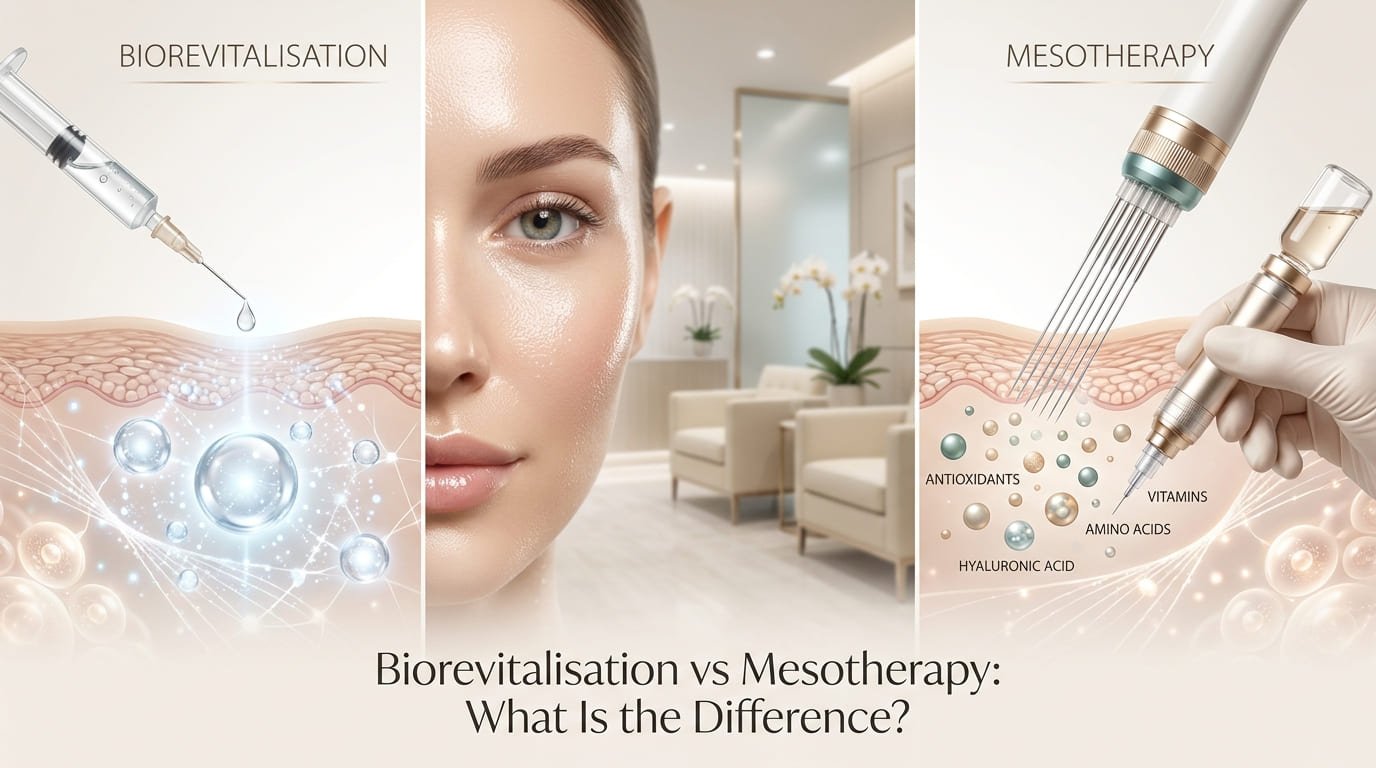
The cocktail injected varies significantly between products and practitioners. A standard mesotherapy formulation in skin rejuvenation will typically contain a combination of non-cross-linked hyaluronic acid at a relatively low to moderate concentration, vitamins including B complex vitamins and vitamin C, minerals, amino acids, antioxidants, and sometimes growth factors, plant extracts, or coenzymes depending on the specific product line being used.
The multi-ingredient approach is the defining characteristic of mesotherapy as it is used in aesthetics today. The treatment is designed to be multi-targeted, addressing several concurrent aspects of skin health and quality in a single session. Hydration comes from the hyaluronic acid component. Cellular nutrition and antioxidant protection come from the vitamin and mineral complex. Collagen synthesis support comes from the amino acid and peptide components. The combination is what produces the broad skin quality improvement that mesotherapy is known for.
Because multiple ingredients are working simultaneously on multiple aspects of skin health, mesotherapy results can vary more between patients and products than treatments with a single, more concentrated active ingredient. The variation in product quality across the mesotherapy market is meaningful. A practitioner who has assessed the specific formulation they use and can explain why they have chosen it is working at a different level from one who simply offers mesotherapy as a category without product-specific knowledge.
Mesotherapy is appropriate for a wide age range and is frequently used for patients in their late twenties and thirties who want to address early signs of skin fatigue, dullness, or dehydration before more advanced structural changes have developed. It is also used for scalp health and early hair thinning, body skin quality, and areas like the décolletage and hands where a light, even injection technique over a broad area suits the anatomy well.
What Biorevitalisation Is and How It Differs
Biorevitalisation emerged from mesotherapy and is, technically speaking, a specific development within the broader mesotherapy category. The distinction that gave it a separate identity was the decision to centre the treatment on a high concentration of non-cross-linked hyaluronic acid as the primary active ingredient rather than spreading the formulation across a wider cocktail of components at lower individual concentrations.
The word biorevitalisation reflects the biological mechanism. High-concentration non-cross-linked hyaluronic acid injected into the dermis does not simply provide hydration at the injection point. The long chains of HA molecules create an osmotic effect that draws water from surrounding tissue into the treated area, producing a deep, sustained hydration effect that goes beyond what a lower concentration formulation delivers. The HA also stimulates the fibroblast activity that drives collagen and elastin production, contributing to a structural improvement in skin quality over the weeks following treatment.
Modern biorevitalisation formulations are not pure hyaluronic acid alone. They typically also contain vitamins, amino acids, antioxidants, and minerals, making the overlap with mesotherapy ingredients significant. The key difference remains the concentration and the primary role of the hyaluronic acid in the formulation. In mesotherapy, HA is one of several ingredients working in parallel. In biorevitalisation, it is the dominant component around which the rest of the formulation is built.
This concentration difference is what makes biorevitalisation particularly effective for patients with more advanced hydration concerns, patients where skin laxity is beginning to develop, and patients in their late thirties and beyond where the skin's own hyaluronic acid production has declined enough to make a high-concentration replacement meaningfully impactful.
The injection technique for biorevitalisation is similar to mesotherapy in that it involves multiple fine injections across the treatment area. The depth of injection and the placement pattern may vary depending on the specific product and the practitioner's protocol. Some products are injected at a slightly deeper dermal level than standard mesotherapy injections to deliver the high-concentration HA where it can have the most structural effect.
One clinical difference that is worth knowing about is that biorevitalisation injections can occasionally produce small, visible papules at injection points in the days following treatment. These are temporary deposits of the high-concentration HA that have not yet fully distributed through the tissue, and they resolve without intervention within a few days. They are not a complication. They are an expected feature of certain biorevitalisation products that patients should be aware of before treatment so they are not alarmed if they notice them.
The Overlap and Where the Boundary Becomes Unclear
Part of the reason these two treatments cause so much confusion is that the boundary between them has genuinely blurred over time as biorevitalisation formulations have become more complex and mesotherapy formulations have incorporated higher concentrations of hyaluronic acid.
There are products on the market today that sit ambiguously between the two categories. A high-quality mesotherapy product from a reputable pharmaceutical manufacturer with a meaningful HA concentration and a strong supporting ingredient complex delivers a result that overlaps significantly with a biorevitalisation product from the same tier of the market. The categorical distinction is real in its original clinical sense. At the product level in contemporary aesthetics, the two categories share more common ground than they once did.
This is actually useful information rather than a frustrating ambiguity. It means that what matters most for your result is not which category label your treatment falls under but whether the specific product being used by your practitioner has the right formulation quality and concentration for your skin concern. A practitioner who knows their products, can explain the rationale behind what they have chosen, and applies it with appropriate technique will produce better results from a well-chosen mesotherapy product than a practitioner using a biorevitalisation product without the same level of clinical understanding.
Comparing the Two Across the Factors That Matter
On primary mechanism, mesotherapy works through a multi-ingredient cocktail approach targeting several aspects of skin health simultaneously. Biorevitalisation works through a high-concentration hyaluronic acid primary mechanism with supporting nutrients built around it.
On best indication, mesotherapy is most appropriate for patients with multiple concurrent mild skin quality concerns including dullness, dehydration, and early fine lines where a broad nutritional approach is the most logical first step. Biorevitalisation suits patients where hydration deficit and early structural skin quality decline are the dominant concerns, particularly where more concentrated hyaluronic acid input is clinically appropriate.
On patient age range, mesotherapy is frequently the more appropriate starting point for younger patients in their twenties and early thirties with early skin concerns. Biorevitalisation has its strongest indication in patients from their mid-thirties onward where the skin's own HA production has declined meaningfully.
On session intervals, both treatments are typically delivered as courses with sessions spaced two to four weeks apart depending on the product and the skin concern being addressed. A standard course for either is usually three to four sessions with maintenance treatments to follow.
On visible papules post-treatment, biorevitalisation products with higher HA concentrations are more likely to produce small temporary injection point deposits than mesotherapy formulations, which typically distribute more evenly and immediately. This is not universal but is worth discussing at consultation so expectations are appropriate.
On combination potential, both treatments sit well within broader skin quality programmes. Mesotherapy complements polynucleotide treatment particularly effectively because the multi-ingredient support creates a healthy cellular environment that enhances the regenerative response polynucleotides drive. Biorevitalisation sits naturally alongside structural injectable treatments like Profhilo or dermal filler where the concentrated HA input reinforces the hydration environment around the structural work.
Where Both Treatments Fit Within a Broader Programme
Neither biorevitalisation nor mesotherapy is designed to function as a standalone solution to all skin quality concerns. Both sit within a broader approach to skin health that typically combines clinical treatment with appropriate homecare and sun protection.
Used as the sole treatment in a patient with mild to moderate skin quality concerns, both can produce meaningful and visible improvement across a course. Used as part of a more comprehensive programme that also addresses structural concerns, pigmentation, or more advanced laxity through complementary treatments, both contribute their specific benefits in a way that supports the overall result.
The right choice between them is not something that needs to be resolved by the patient before consultation. It is something that becomes clear once a practitioner has assessed your skin, understands your primary concerns, and knows which formulation in their portfolio is most appropriate for your specific presentation. The clinical decision is more nuanced than the marketing language around either treatment suggests, and a practitioner who treats it as such is the one most likely to recommend the right thing for your skin.
Frequently Asked Questions
Can I have both biorevitalisation and mesotherapy as part of the same programme?
Yes. The two treatments are not mutually exclusive and some practitioners build programmes that use both, with one addressing the concentrated hydration and structural support need and the other contributing broader nutritional and antioxidant support at different points in the programme.
How quickly will I see results from either treatment?
Some improvement in skin radiance and hydration is often noticeable after the first session. The more significant structural and quality improvements build progressively across a course of three to four sessions and continue to develop for some weeks after the final session.
Are there any patients who should not have these treatments?
Both treatments are contraindicated during pregnancy and breastfeeding. Patients with active skin infections, certain autoimmune conditions, or a known allergy to any component of the specific formulation being used should not proceed. A full medical history review at consultation is essential before either treatment.
Will I be able to see which treatment my clinic uses from their website?
Not always. Many clinics list these treatments under broad category names without specifying the product used. Asking directly about the specific product, its HA concentration, and the reasoning behind the choice is a reasonable and informative question to raise at consultation.
How does biorevitalisation differ from Profhilo?
Profhilo uses a specifically patented high-concentration non-cross-linked HA formulation with a defined injection protocol and a bio-remodelling mechanism that is backed by a significant body of clinical evidence. Biorevitalisation is a broader category that includes various products from different manufacturers. Profhilo is a specific, branded form of what would broadly be classified as biorevitalisation, with its own distinct clinical profile.
Is either treatment painful?
Both involve multiple fine needle injections across the treatment area. Most patients find both treatments very tolerable, particularly with topical numbing cream applied before the session. The fine gauge of the needles used and the relatively shallow injection depth for most applications means discomfort is typically minimal.
If you are not sure whether biorevitalisation, mesotherapy, or a different skin quality treatment is the right fit for your skin, book a consultation at our Littlehampton or Hove clinic. We will assess your skin properly before recommending anything.
Book a Consultation in Littlehampton or Book a Consultation in Hove