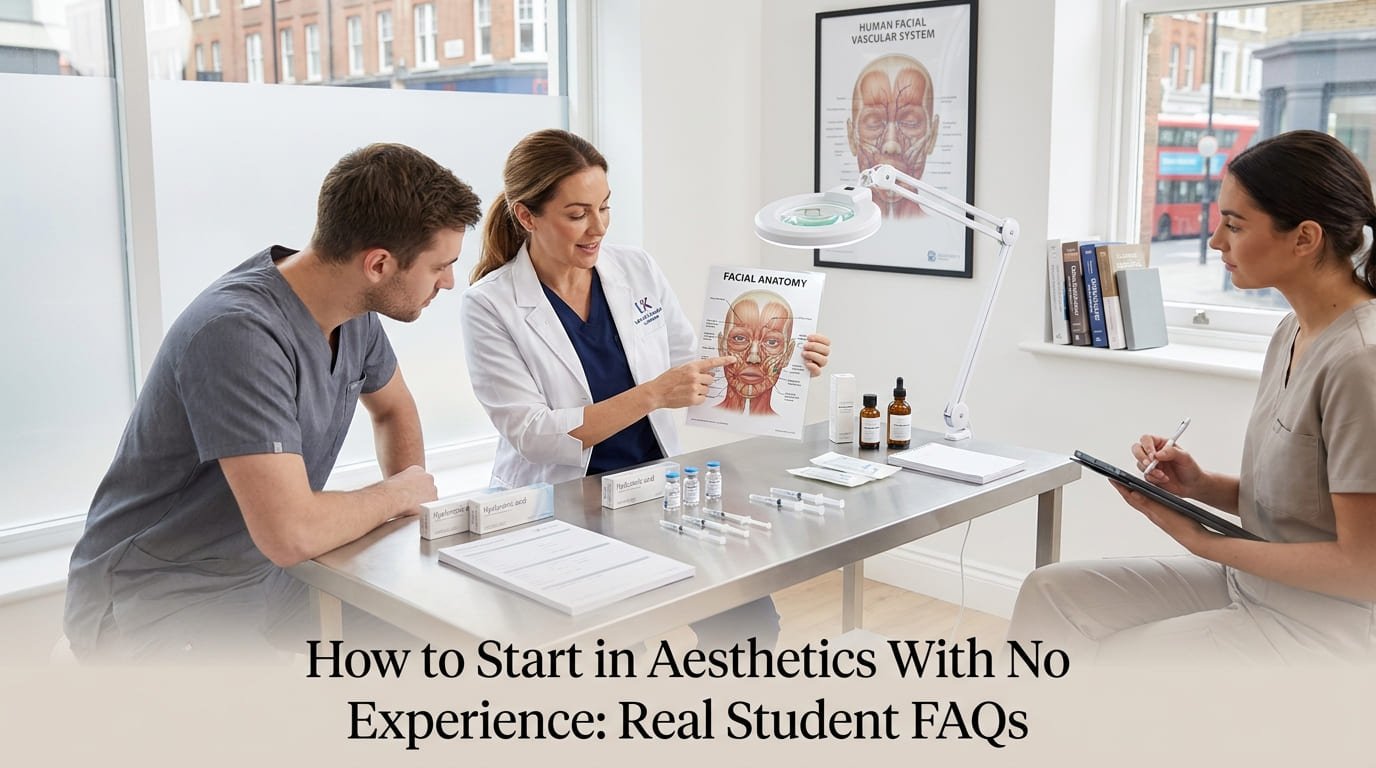
The phrase "starting in aesthetics with no experience" covers a very wide range of situations. It includes the nurse who has spent fifteen years in clinical practice and has no aesthetic experience but has clear professional foundations to build from. It includes the dentist who understands facial anatomy in clinical depth but has never worked outside a dental setting. It includes someone considering nursing or another healthcare qualification specifically because they want to move into aesthetics eventually. And it includes people who are entirely at the beginning of thinking about this as a direction and do not yet have a clear sense of what the path looks like.
Each of these situations requires a different answer and a different starting point. The questions that follow represent the ones that come up most consistently from people at the very beginning of considering aesthetic practice as a career direction, whether they are close to the entry point or still working toward it.
I have no medical background at all. Can I train in aesthetics?
This is the first question many people ask and it deserves an honest answer rather than a vague one.
Injectable aesthetic treatments, which cover anti-wrinkle injections and dermal filler, use prescription-only medicines in the UK. This means they cannot be legally prescribed, supplied, or administered without a regulated healthcare professional being part of the process. The entry requirement for injectable aesthetic training is not arbitrary. It reflects the legal and clinical reality of what the treatments involve.
If you have no regulated healthcare professional background at all, you cannot currently practise injectable aesthetics in the UK legally. No training certificate changes this. A person without a regulated healthcare professional registration who completes an injectable training course cannot obtain the insurance needed to practise, cannot access the prescribing pathway the treatments require, and is not operating within the framework that protects both patients and practitioners.
The honest path forward for someone in this position is to train as a healthcare professional first. Registered nursing is the most common route. A nursing qualification provides the clinical foundation, the professional registration, and in many cases the prescribing access that makes aesthetic training genuinely applicable to practice. Nursing apprenticeships, traditional degree routes, and accelerated programmes for graduates are all available pathways depending on your starting point and circumstances.
Non-injectable aesthetic treatments, including chemical peels at certain concentrations, skin boosters in some regulatory contexts, and other non-prescription interventions, have different entry requirements and may be available to practitioners from a broader range of professional backgrounds. These are worth researching separately if your interest lies specifically in skin treatments rather than injectables.
I am a registered nurse. Where do I start?
A registered nurse with an active NMC PIN is well positioned to enter aesthetic training. The clinical foundation that nursing provides, including anatomy knowledge, patient assessment experience, injection technique from clinical practice, and an understanding of medical emergencies and contraindications, gives you a genuine head start over someone with no clinical background.
The starting point for a nurse entering aesthetics is foundation-level injectable training. Foundation training in dermal filler and anti-wrinkle treatment covers the specific anatomy of the face relevant to aesthetic injections, the clinical pharmacology of the products used, consultation and informed consent practice, injection technique for the core treatment areas, and complications management.
Before you book foundation training, confirm your insurance position. NHS indemnity does not cover aesthetic practice outside a clinical NHS setting. Independent aesthetic practice requires separate specialist aesthetic insurance, and you should confirm with your insurance provider what evidence of training they require before you practise each treatment type.
Confirm your prescribing position. Anti-wrinkle treatment using botulinum toxin and dermal filler using prescription-only HA products require a prescribing pathway. If you are an independent prescriber, this is within your scope. If you are not, you need to work within a clinical governance arrangement with a supervising prescriber until prescribing qualifications are in place. The practicalities of this vary and are worth establishing clearly before your first patient appointment.
Revalidation requirements with the NMC continue regardless of your aesthetic work. Aesthetic CPD contributes to your revalidation evidence and a good training provider will issue certificates structured to support this.
I am a dentist. Is aesthetic training different for me?
Dentists registered with the GDC are well suited to aesthetic injectable practice. Detailed anatomical knowledge of the facial region, extensive clinical training in injection technique, prescribing rights within professional scope, and experience managing patients through procedure anxiety are all transferable directly into aesthetic practice.
The main adjustment for dentists entering aesthetics is extending anatomical awareness from the oral and perioral region into the full face. Advanced treatment areas including the cheeks, temples, tear troughs, and jawline require anatomical knowledge that dental training covers in some areas more thoroughly than others. A foundation and then advanced training pathway builds this knowledge in a structured way.
The professional indemnity position for dentists practising aesthetics is worth checking with your defence organisation. Some dental defence organisations cover aesthetic treatment as an extension of professional practice, and others do not. Specialist aesthetic insurance alongside your dental indemnity may be the appropriate arrangement depending on your specific coverage.
What does the training pathway actually look like from beginning to end?
A well-structured training pathway in aesthetics is progressive rather than comprehensive from the outset. Beginning with everything at once is not clinically appropriate, and the best training programmes reflect this.
Foundation injectable training is the starting point for most practitioners new to aesthetics. It introduces the core treatment areas, the fundamental anatomy, the consultation and consent process, and the complications management principles that underpin everything that follows. Foundation training is the entry point, not the destination.
Advanced filler training follows once the foundation treatment areas are consolidated in clinical practice. It extends into the more complex anatomical areas including cheeks, temples, tear trough, and structural facial contouring that require a higher level of anatomical precision and clinical confidence than foundation areas demand. The step to advanced training is appropriate when you have treated enough foundation patients to feel genuinely comfortable with the basics rather than still working through the uncertainty that comes with early practice.
Complications management training sits alongside and reinforces the whole injectable pathway rather than sitting neatly at a particular point in it. Completing complications management training after foundation and before significant independent practice is the clinical safety standard that the best practitioners meet. It is not a sign of inadequacy. It is the investment in the knowledge that protects both you and your patients when something unexpected happens.
Skin treatment training, including chemical peels, biorevitalisation, mesotherapy, and BioRePeel, can be developed alongside or independently of the injectable pathway depending on your practice direction. Many practitioners build a skin treatment skill set in parallel with their injectable training because the two categories complement each other in clinical practice and in building a sustainable patient base.
Specialist training in fat dissolving, polynucleotides, thread lifting, and wellness injectables follows as practice and patient demand develop. Each specialist area has its own anatomy, its own complications profile, and its own learning curve, and is best approached after the practitioner has a functioning aesthetic practice rather than before they have treated their first patient.
How long does it take to build a functioning aesthetic practice?
This is the question that deserves the most honest answer because it is the one where the gap between expectation and reality is most significant.
The training itself, from first foundation course through to a reasonably comprehensive skill set, takes a minimum of twelve to eighteen months if it is paced appropriately. Rushing this does not produce a better practitioner. It produces an undertrained one.
Building a patient base from zero takes significantly longer than most people expect and varies enormously depending on several factors. Starting with an existing patient relationship, such as a nurse who already has a patient population from clinical practice, produces a faster early caseload than starting entirely from scratch. Working within an established clinic or alongside an experienced practitioner as a first step is both commercially and clinically sensible for most new practitioners.
The financial return from aesthetic practice in the early months is almost always lower than people project when they are planning their entry. The per-treatment revenue in aesthetics is meaningful but the volume of patients in months one through twelve of a new practice is typically much lower than a sustainable practice requires. Planning for this financially before you begin is more useful than being surprised by it after.
A realistic picture of a functioning, sustainable aesthetic practice that provides a meaningful income without a pre-existing patient base is two to three years from the point of starting training. Some practitioners get there faster with the right circumstances. Others take longer. Being honest about this timeline before beginning is the preparation that prevents practitioners from giving up during the difficult early period.
What is the difference between good and poor quality training?
The training market in UK aesthetics is not uniformly regulated, and the quality difference between providers at different ends of the market is genuinely significant. Knowing what distinguishes a good course from a poor one is one of the most useful things a new practitioner can know before spending money on training.
Good training is delivered by a trainer with extensive personal clinical aesthetic practice rather than someone who moved quickly from training to teaching. The questions that arise during practical training and in early independent practice are answered from real clinical experience, not from course materials alone.
Good training keeps delegate numbers small enough that each practitioner receives meaningful individual supervision during the practical element. A group of twelve practitioners sharing a single trainer cannot receive the same quality of hands-on feedback as a group of four or six.
Good training covers complications management with genuine clinical depth rather than a brief mention. Vascular occlusion recognition, hyaluronidase management, and the management of less acute but common complications are taught specifically rather than generally.
Good training provides post-course support. The questions that matter most in clinical practice often arise weeks or months after the training day when you are face to face with a patient who presents something you have not encountered before. A trainer who is accessible beyond the course day adds a safety margin to early independent practice that course materials cannot provide.
Poor training often prioritises low cost and high volume over clinical quality. A one-day course covering multiple treatment areas at a price point significantly below market is almost certainly compromising on something that matters. Finding out what is being compromised before you book is more useful than finding out after.
How do I find my first patients?
This question is practical and important and is often not addressed honestly in training marketing.
Your first patients are almost always within your existing network. Former colleagues who know your professional background and trust your clinical judgement. Friends and family who want to support you while you are starting. Patients from your existing healthcare role who ask whether you offer aesthetic treatments.
Social media is the primary marketing tool for most new aesthetic practitioners, and it takes consistent time and effort to build a following that generates meaningful enquiries. Content that demonstrates your knowledge, your approach, and your clinical thinking builds trust with potential patients over time. Results photography with patient consent builds a visible portfolio. Patient reviews generate the social proof that new patients look for before booking.
Working within an established aesthetic clinic as an associate or renting a room from a clinic that already has a patient base is the fastest route to early clinical volume because the clinic's existing marketing and reputation generate enquiries that you benefit from. The trade-off is the financial arrangement with the clinic, but for most new practitioners, the access to patients and the support of an established clinical environment is worth it in the early stage.
The period between completing training and having a consistently busy practice is the hardest part of building an aesthetic career and the one that filters out the practitioners who were not genuinely committed to the field from those who were. Consistency during this period, in clinical quality, in patient communication, and in continuing to invest in training and professional development, is what gets practitioners through it.
Is aesthetics the right career for me?
This is the question underneath all the others, and it is worth answering directly.
Aesthetic practice suits practitioners who are genuinely interested in skin biology, facial anatomy, and the art of producing natural, proportionate results. It suits people who find the consultation as rewarding as the treatment, because the quality of the clinical relationship you build with patients is as important as the technical skill of the injection. It suits people who are comfortable with a degree of commercial uncertainty, particularly in the early years, and who have the resilience to build a patient base from modest beginnings.
It does not suit practitioners who are primarily motivated by the income projections they have seen on social media or who expect rapid financial return from minimal training investment. The practitioners who build genuinely successful aesthetic careers are those who invest seriously in their clinical development, who prioritise patient outcomes over volume, and who approach every new treatment area with the same respect for anatomy and safety they brought to their foundation training.
The most useful thing you can do before committing to aesthetic training is spend time talking to practising aesthetic clinicians about the reality of their working lives rather than relying on the curated version that training marketing and social media present.
Frequently Asked Questions
Can I train in aesthetics while still working full time in my current NHS or clinical role?
Yes, and many practitioners do. Weekend and evening training courses are available, and the early stage of building a patient base can be managed around existing employment commitments. The challenge is time rather than compatibility, and most practitioners who transition into aesthetics do so gradually rather than all at once.
How much does aesthetic training cost and can I finance it?
Training costs vary significantly by provider, course level, and course format. Foundation injectable training from reputable providers typically starts at several hundred pounds and increases for advanced and specialist courses. Some training providers offer payment plans. Treating training as a professional investment with a realistic return timeline rather than an immediate cost is the financial frame that most experienced practitioners would recommend.
Do I need my own equipment and products before I start treating patients?
You will need to source pharmaceutical-grade products through appropriate supply channels, for which you need your professional registration. Equipment including needles, cannulas, and clinic consumables is available from aesthetic supply companies. Your insurance provider will confirm any specific requirements around equipment and product standards.
What professional body should I join as an aesthetic practitioner?
The British College of Aesthetic Medicine, the Joint Council for Cosmetic Practitioners, and Save Face are among the main professional bodies and registers relevant to UK aesthetic practice. Membership of an appropriate body demonstrates commitment to professional standards and is increasingly something patients check before booking with a new practitioner.
How do I know if a training provider is reputable?
Ask for accreditation details and verify them. Ask about the trainer's clinical background specifically. Ask about complications management coverage. Ask about post-course support. Ask other practitioners in your network about their experience with the provider. The aesthetics community in the UK is active on social media and in professional forums, and the reputation of training providers is discussed openly in these spaces.
If you are at the beginning of thinking about an aesthetic career and want an honest conversation about the pathway that makes sense for your specific background and situation, get in touch with the Angel White Aesthetics training team. We would rather answer your questions before you book than have you discover important information after you have already committed.
Explore the Training Programme or Contact the Training Team