The reversibility of filler is one of the most reassuring clinical facts in aesthetic medicine and one of the most commonly misunderstood. A significant number of people who are considering their first filler appointment hold back because they worry they will be stuck with a result they do not like. Others have had filler elsewhere, are unhappy with some aspect of the result, and want to understand whether anything can be done about it.
The short answer is yes. Hyaluronic acid filler can be dissolved. It is not a permanent intervention, and it is not irreversible. Understanding how dissolution works, when it is the right choice, what the process involves, and what to expect afterward gives you a genuinely complete picture before you make any decision about either having filler or having existing filler removed.
This article covers everything with clinical accuracy and without overstating what the process can and cannot deliver.
Why HA Filler Can Be Dissolved
Hyaluronic acid is the most widely used filler material in UK aesthetic practice for several reasons, and its reversibility is a significant part of why medically trained practitioners prefer it over permanent alternatives.
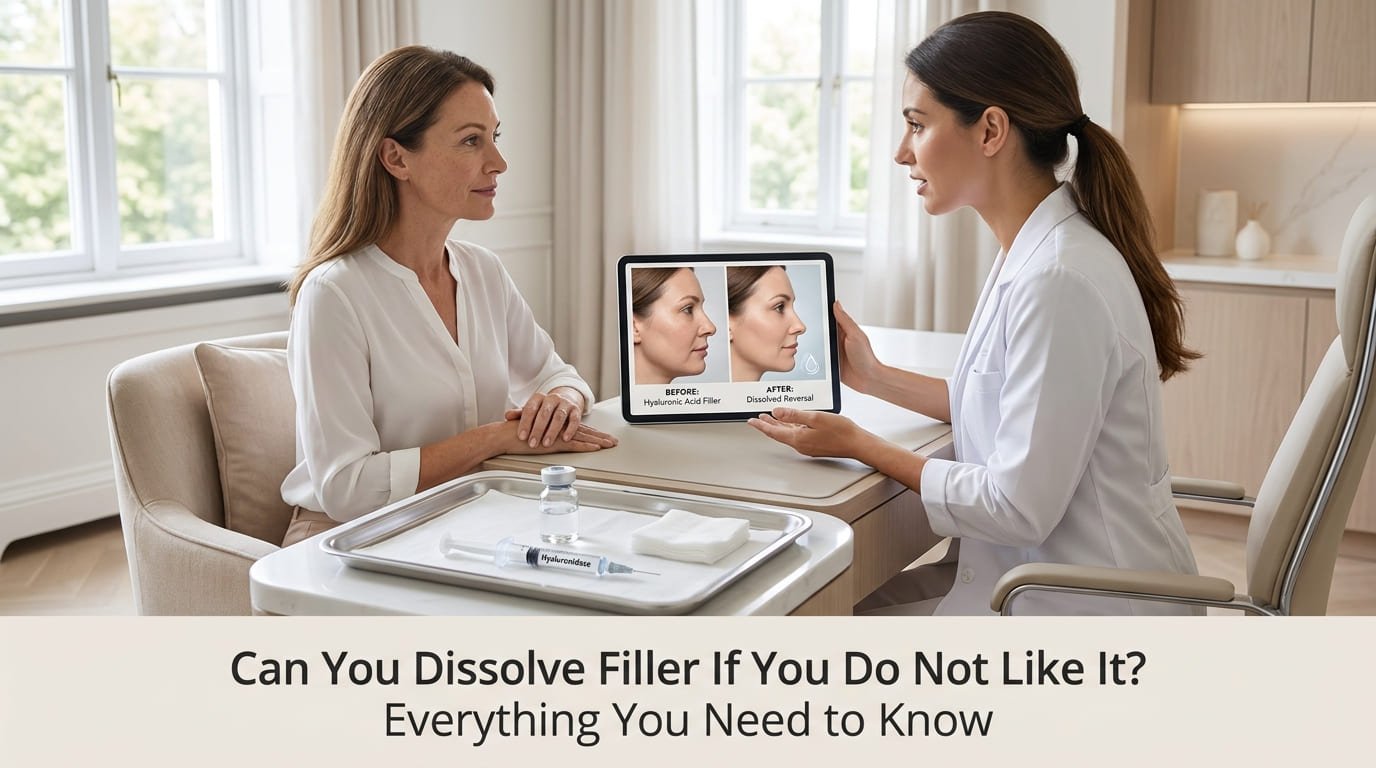
The body contains an enzyme called hyaluronidase naturally. It is part of the normal biological mechanism that breaks down hyaluronic acid in tissue throughout the body. When a pharmaceutical-grade version of this enzyme is injected near or into an area containing HA filler, it dramatically accelerates the breakdown of that specific HA product. A volume of filler that would naturally metabolise over months or over a year is broken down within hours to days of the hyaluronidase injection.
This mechanism is entirely dependent on the filler being hyaluronic acid based. Hyaluronidase does not dissolve calcium hydroxylapatite, which is the material in Radiesse. It does not dissolve permanent fillers including PMMA or silicone-based products. It does not dissolve polylactic acid products. If you have had treatment with a non-HA product and want it removed, the options are significantly more limited and more complex.
The vast majority of filler used in reputable UK aesthetic practice is HA based precisely because the reversibility it allows is a meaningful clinical safety advantage. A practitioner who uses HA products is offering you not just a treatment result but an exit route if needed.
When Dissolving Filler Is the Right Decision
There are several distinct situations in which dissolving filler is clinically appropriate, and understanding the difference between them helps you assess whether dissolution is the right path for your specific situation.
Aesthetic dissatisfaction is the most common reason patients request dissolution. The result does not match what was hoped for. The lips look heavier than intended. The cheeks feel unnatural. A specific area looks asymmetrical in a way that has not resolved on its own. In these cases, dissolving the filler allows the area to return to its pre-treatment baseline, the swelling to settle, and a reassessment to take place before any retreat if desired.
Filler migration is a specific presentation that develops over time when product placed in one area gradually shifts to an adjacent area. Lip filler is the most commonly discussed example, where product originally placed within the lip border gradually becomes visible as a slight ledge or roll above or below the natural lip line. Targeted hyaluronidase can dissolve this misplaced product specifically without necessarily removing all of the filler in the area.
Overfilling, whether from a single treatment or from accumulated volume across multiple treatments over time, is an increasingly common indication for dissolution. Patients who have had regular filler for years sometimes find their facial proportions have shifted in a direction they no longer want. Dissolving the accumulated filler and returning to a natural baseline before reassessing the approach is a legitimate and increasingly requested clinical pathway.
Emergency dissolution for vascular complications is the most clinically urgent application of hyaluronidase and is covered in specific detail in the dedicated hyaluronidase article on the Angel White blog. This is the use case where the speed and availability of hyaluronidase at the treating clinic is most critically important and where the outcome for the patient depends directly on how quickly the enzyme is administered following a vascular event.
When Dissolving Filler Is Not Necessary
Not every situation that feels like a problem in the first days after filler requires dissolution and it is worth being clear about this before the request is made.
The most common misapplication of the dissolution request is in the first few days after filler when swelling, asymmetry from uneven inflammation, and the unfamiliar sensation of the new result creates anxiety that the result is wrong. In the vast majority of these cases the result has not yet settled and what feels like a problem resolves naturally by the two-week assessment point.
Dissolving filler at two days post-treatment because it looks and feels different from the settled result is almost always premature. The decision to dissolve should be made after the area has fully settled, which takes a minimum of two weeks, and after a proper clinical assessment of the settled result rather than the immediate post-treatment presentation.
This is why the two-week review appointment is a clinical tool rather than just a box-ticking formality. It is the appropriate point at which a genuine assessment of the result can be made and at which the decision to adjust, maintain, or dissolve is based on clinical information rather than the anxiety of an unsettled post-treatment period.
What the Dissolution Process Involves
The hyaluronidase treatment itself is a straightforward injectable procedure. The enzyme is drawn up and injected into or adjacent to the area where the filler to be dissolved is located. The needle used is typically very fine and the injection process is comparable in sensation to the filler treatment itself. Topical numbing cream can be applied before if needed.
The number of injection points varies depending on the size of the area being treated and how the filler is distributed within it. A small, localised area of migrated lip filler may require only a few injection points. Dissolving a larger area of accumulated filler across the cheeks or midface involves more points across a broader treatment zone.
The dissolution effect begins within hours of the injection. Most patients notice a visible reduction in the treated area within 24 to 48 hours as the hyaluronidase breaks down the HA product. The full dissolution of the treated area is typically apparent at around three to five days, though some residual swelling from the injection itself may persist for a similar period and should not be confused with remaining filler.
Bruising is possible after a hyaluronidase injection as after any injectable procedure. The perioral and periorbital areas are more prone to visible bruising and patients who have dissolution in these areas should plan for up to a week of potential bruising.
What Dissolving Filler Feels Like Versus What It Looks Like
There is an important distinction between the tactile experience of dissolution and the visual experience, and patients who are not prepared for this distinction sometimes find the process more alarming than necessary.
During the first 24 to 48 hours after hyaluronidase injection, the treated area may feel unusually soft or deflated in a way that is quite different from both the pre-filler baseline and the treated appearance. This is the filler being broken down rapidly. It does not feel like the face gradually returning to its natural state. It feels like a more abrupt change in the tissue.
The visual appearance after dissolution, once swelling from the injection itself has resolved, reflects the pre-filler baseline rather than any new condition created by the dissolution process. The tissue returns to its natural state without the filler support. In areas where volume loss existed before the filler was placed, that volume loss will be visible again once the filler has been removed. This is not a side effect of dissolution. It is simply what was present before the filler was added.
This is an important expectation to set before dissolution, particularly for patients who have had filler for a long time and may not have a clear memory of or emotional readiness for their pre-filler appearance. The tissue returns to where it was before, not to a worse state.
Can All Filler Be Dissolved in One Session
Whether all the filler in a treated area can be fully dissolved in a single session depends on the volume present, how long the filler has been in the tissue, and how integrated it has become.
Recently placed filler, within the last few months, is generally more completely dissolved by a first session of hyaluronidase because the product is still relatively intact in the tissue. Filler that has been present for a year or more becomes partially integrated into the surrounding tissue as the HA is naturally metabolised and the residual product is sometimes less completely responsive to a single hyaluronidase treatment.
In cases where a significant amount of accumulated filler from multiple treatments over years is being dissolved, two or three sessions of hyaluronidase may be needed to achieve a fully satisfactory baseline. Sessions are typically spaced two to four weeks apart to allow the first session's dissolution to complete fully before the second is assessed and performed.
A single session of hyaluronidase is almost always sufficient for dissolving a specific, recently placed treatment where the indication is aesthetic dissatisfaction rather than accumulated volume from years of treatment.
How Long to Wait Before Retreating
After dissolving filler, waiting before replacing it is important for two reasons. The hyaluronidase that has been injected remains active in the tissue for a short period after the initial dissolution is complete. Placing new HA filler too soon after hyaluronidase risks the new product also being partially broken down by residual enzyme activity.
The standard guidance is to wait a minimum of two weeks before placing new HA filler after hyaluronidase treatment. Some practitioners recommend four weeks, particularly after a more significant volume of hyaluronidase has been used. This waiting period allows the enzyme to fully clear from the tissue and the area to return to its settled baseline, which gives the practitioner an accurate assessment of the starting point for any retreatment.
The waiting period also serves the important function of giving you time to assess your natural baseline before deciding whether and what to retreat. The settled appearance after dissolution, without the influence of recent swelling or the immediate emotional response to the dissolution process, is the most useful reference point for planning any retreatment.
Dissolving Filler From a Different Clinic
A question that comes up consistently is whether a different clinic from the one that originally placed the filler can perform the dissolution. The answer is yes and this is a service that Angel White Aesthetics provides for patients who had filler elsewhere.
Hyaluronidase does not require any specific knowledge of which product was originally used in order to work effectively, provided the product was HA-based. It dissolves HA regardless of the manufacturer. A thorough clinical assessment of the area before dissolution is important so the practitioner understands what they are dissolving and can plan the approach accordingly, but this assessment can be conducted by any suitably qualified practitioner rather than only the one who originally treated you.
If you had filler placed by a previous provider and have concerns about the result that you want addressed, you do not need to return to that provider. A consultation at Angel White allows the current situation to be assessed properly before a dissolution plan is made.
The Patch Test Question
Hyaluronidase can cause allergic reactions in a small number of patients. A patch test is recommended in specific clinical circumstances rather than universally for all patients, particularly where there is a known or suspected sensitivity to bee or wasp venom, as a cross-reactivity risk exists.
This is something your practitioner will discuss during the consultation before dissolution is performed. In most patients, there is no need for a formal patch test and the risk of an adverse reaction to hyaluronidase is low. The treatment should always be performed in a clinical setting with access to anaphylaxis management as a standard clinical safety measure.
Realistic Expectations for the Outcome
Dissolution returns you to your pre-treatment baseline. It does not produce a better outcome than you had before filler. It does not treat the underlying volume loss, skin laxity, or structural concerns that prompted the original filler treatment. It simply removes the intervention.
Patients who dissolve filler and feel their natural baseline is something they want to address through treatment again have the option of reassessing and replanning from a clean starting point. Patients who dissolve filler and find their natural baseline is something they are comfortable with can simply leave it.
Neither outcome is better or worse in clinical terms. The goal of dissolution is to return control to the patient rather than to produce any specific new appearance. That control is itself the value of the treatment.
Frequently Asked Questions
Will dissolving my filler hurt?
The process is comparable in sensation to having filler placed. Topical numbing cream can be applied before if needed. Most patients find it well tolerated.
Can I have a filler appointment at the same session as dissolution?
No. Waiting at least two weeks after hyaluronidase before placing new HA filler is the standard clinical guidance to allow residual enzyme activity to clear before new product is introduced.
Does dissolving filler leave the area looking worse than before I ever had it?
No. Dissolution returns the tissue to its pre-filler state. The concern about looking worse after dissolution typically reflects the patient imagining their current treated appearance as the new normal and comparing backward from there, rather than comparing to their pre-treatment baseline, which is what the area actually returns to.
How do I know if my filler is HA-based and therefore dissolvable?
Ask your original practitioner what product was used. If you do not know and the practitioner is not contactable, a consultation allows an assessment of the tissue to be made before dissolution is planned. If there is genuine uncertainty about the product type, your practitioner will discuss the appropriate approach.
Can hyaluronidase dissolve filler that is years old?
Yes, though older filler that has become partially integrated into surrounding tissue may respond less completely to a single session. Multiple sessions spaced two to four weeks apart are sometimes needed to achieve full dissolution of longstanding accumulated filler.
Is it safe to have filler dissolved during pregnancy?
Hyaluronidase is contraindicated during pregnancy. If you are pregnant and have concerns about existing filler, waiting until after delivery before dissolving is the appropriate approach unless a clinical emergency makes earlier intervention necessary.
If you have concerns about existing filler and want an honest assessment of whether dissolution is appropriate for your situation, book a consultation at our Littlehampton or Hove clinic. We see patients with filler from other providers and are happy to assess and advise before any decision is made.
Book a Consultation in Littlehampton or Book a Consultation in Hove