The fear of looking frozen is the single most consistent reason people sit with anti-wrinkle treatment on their mind for months or years without actually booking. They want the result but they are afraid of the version of it they have seen in photographs, on television, or on someone they know who had too much done by someone who did not know how to do it well.
This fear is understandable. The frozen, expressionless face that most people picture when they worry about looking unnatural is real. It exists. It is a result of anti-wrinkle treatment applied in a way that does not reflect good clinical practice. But it is not inevitable. It is not what well-delivered anti-wrinkle treatment looks like. And understanding the difference between those two outcomes is what makes it possible to move from hesitation to an informed decision.
What Anti-Wrinkle Treatment Is Actually Doing
Before discussing what natural looks like, it helps to understand what the treatment is actually doing in the muscle because this shapes what is and is not possible from the treatment.
Anti-wrinkle injections use botulinum toxin type A to temporarily reduce the strength of contraction in specific facial muscles. They do not paralyse muscles completely in a well-delivered treatment. They reduce the force of contraction to a degree that prevents the skin above from creasing deeply, while leaving enough residual movement for normal expression to occur.
This distinction between reducing contraction and eliminating it is the most important clinical point in understanding why good anti-wrinkle treatment does not produce a frozen appearance. A face that retains movement, that can raise its eyebrows in surprise and furrow its brow in concentration and smile with genuine animation, simply looks like a face that is functioning normally. What it does not do is form the deep, repeated creases from those expressions that create permanent wrinkle lines over time.
The frozen appearance comes from over-treatment. From too much product placed in too many areas or in areas that affect the key muscles of expression too strongly. It is a dosing and placement error rather than an inherent property of the treatment. A face where virtually no movement is possible in the treated areas does not look refreshed. It looks like something is wrong. This is precisely what does not happen when the treatment is delivered with appropriate clinical judgement.
What a Natural Anti-Wrinkle Result Actually Looks Like
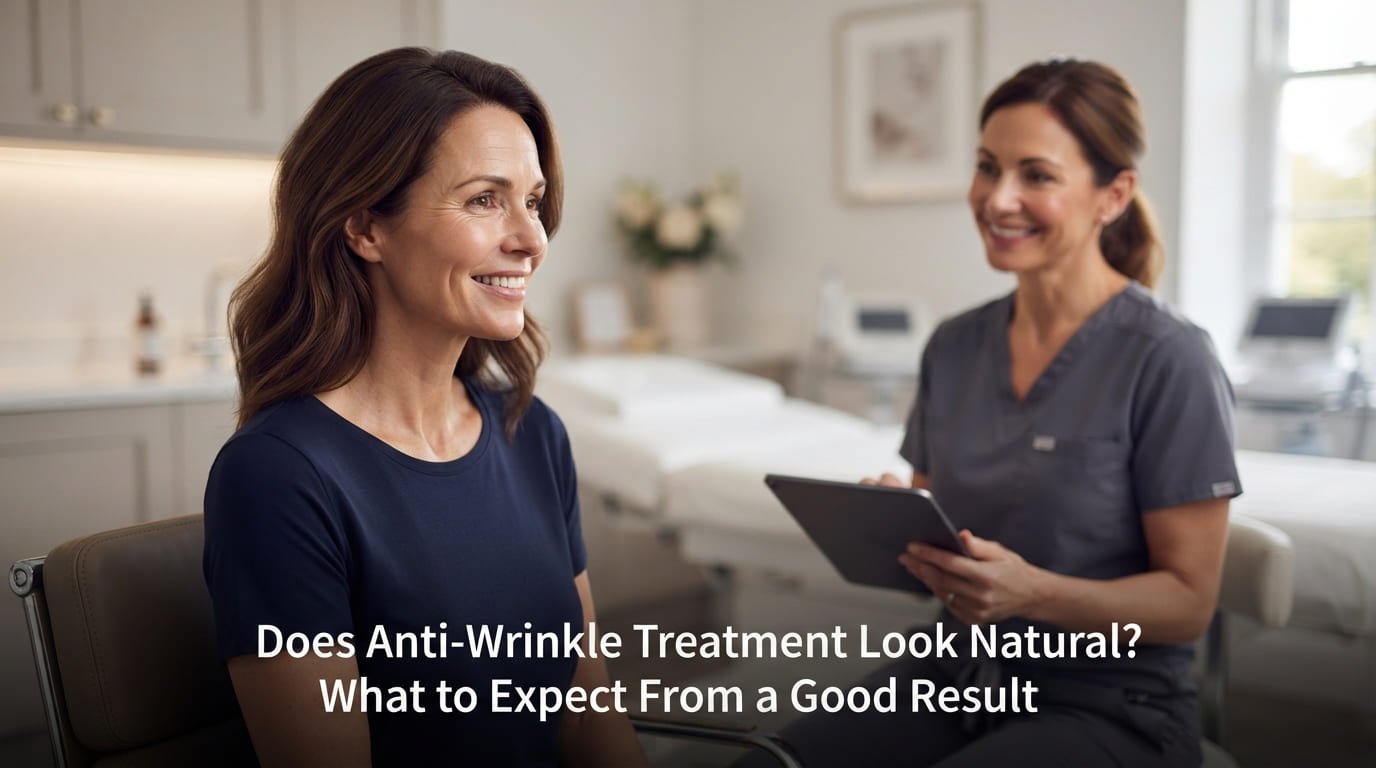
A well-delivered anti-wrinkle result does not produce a visible change that other people can readily identify as treatment. This is the outcome that most patients actually want and it is achievable when the dosing and placement decisions reflect what the individual patient's face actually needs.
You look rested. The forehead is smoother than it was before treatment. The lines that appeared when you frowned or raised your eyebrows are softer or significantly reduced. The crow's feet that spread from the corners of your eyes when you smile are less pronounced. These are real improvements that are visible in photographs and in person.
What you do not look like is expressionless. Your eyebrows move. Not quite as dramatically as before treatment, but enough that your face communicates normally. You can still raise one eyebrow. You can still frown when concentrating. You can still smile and have that smile reach your eyes. The expressions are present. The lines they previously created are reduced.
People around you notice something. Most of them cannot identify what it is. You look better. You look more rested. You look somehow younger than the last time they saw you. They do not think you have had treatment. They think you have been on holiday or got more sleep or changed something about your routine. That is what a natural anti-wrinkle result produces in the people who see you regularly.
This is not a hypothetical description of a perfect outcome. It is a consistent and reliably achievable result from treatment delivered at an appropriate dose by a practitioner who understands how to match the treatment to the specific patient's anatomy and expression patterns.
Why Some Results Look Unnatural
Understanding what produces an unnatural result is just as useful as understanding what produces a natural one because it gives you the knowledge to distinguish between them when you are evaluating practitioners and making decisions.
Over-treatment is the primary cause of the frozen appearance that most people are afraid of. When the dose used exceeds what is appropriate for the individual patient and the targeted muscles are reduced below the threshold that allows normal expression, the face loses the animation that makes it look alive and natural. The forehead becomes completely flat in a way that looks wrong in motion even when it might look smooth in a static photograph. The brows can become heavy or drop if the dose affects muscles responsible for brow elevation more than intended. The face looks set rather than expressive.
Inappropriate placement creates specific unnatural results even at doses that might be appropriate in other areas. Forehead anti-wrinkle treatment placed too low or in a pattern that does not reflect the individual patient's muscular anatomy can produce a Spock-like brow elevation in the outer portion of the brow that is immediately visible as a treatment effect. Treatment in the perioral area performed without precise understanding of which muscles are being affected can produce asymmetry in smiling or difficulty with certain mouth movements.
Treating an individual who is not an appropriate candidate for the specific type of treatment requested produces results that do not look natural because the treatment is not matched to what the face actually needs. A patient with very significant skin laxity who expects anti-wrinkle injections alone to address the appearance of their forehead may find that relaxing the muscle reveals the overlying skin laxity more clearly. This is not a treatment failure in the technical sense but it is a consultation failure if it was not anticipated and discussed honestly before treatment.
The Role of Dose and Why It Is Individualised
The dose of anti-wrinkle product used in any treatment is not standardised across patients. It is not a fixed number that applies equally to every forehead or every set of crow's feet. It is a clinical decision made by the treating practitioner based on an assessment of the individual patient's muscle strength, skin quality, age, existing lines, and the result they are aiming for.
Patients with strong, well-developed facial muscles from years of very animated expression require a different dose from patients with finer, less developed musculature to achieve the same degree of movement reduction. Men typically require higher doses than women because male facial muscles are generally stronger. First-time patients whose muscles have never been treated often respond more dramatically to a given dose than patients who have been receiving treatment for years and whose muscles have been gradually influenced over time.
A practitioner who uses the same dose for every patient regardless of these factors is not practising good clinical medicine. They are applying a protocol that will produce appropriate results for some patients and under-treated or over-treated results for others depending on whether their individual muscle characteristics happen to match the assumed average.
The consultation before anti-wrinkle treatment is where the dose decision is made. A proper assessment includes asking you to perform specific expressions so the practitioner can observe how strongly the targeted muscles contract, where the lines form, and how the skin above them responds. This information is what guides the dosing decision. A practitioner who books you in without this assessment is guessing rather than planning.
What You Can Do to Get a Natural Result
The most direct influence you have over whether your result looks natural is the decisions you make before you book rather than during the treatment itself.
Choosing a practitioner with the clinical training, registration, and experience to make the assessment and dosing decisions described above is the most important factor. A registered nurse, doctor, or dentist with specific aesthetic injectable training and genuine experience across a range of patient types is better positioned to make these judgements than someone without a clinical background or with only superficial training.
Communicating clearly at consultation about what you want and what you are afraid of is the second most important factor. Telling your practitioner that you want to look refreshed rather than treated, that you are concerned about looking frozen, and that you want to maintain the ability to make normal expressions is information they need to calibrate their approach. Most practitioners who are asked directly to prioritise natural movement over complete line elimination will adjust their approach accordingly and many will start at a conservative dose to assess your individual response before committing to a higher level.
Starting at a conservative dose for your first treatment and building from there is a sensible approach that most good practitioners will recommend for patients who are new to anti-wrinkle treatment or who are concerned about the outcome. A lighter first treatment that produces a natural, movement-preserving result gives you real information about how your face responds. If you want more effect in subsequent treatments, that can be built on. Starting too high cannot be undone until the treatment wears off.
Being honest about your life context also helps. A wedding, a significant work event, or any occasion where you will be filmed or photographed extensively and where an unfamiliar appearance would be more stressful than reassuring is worth mentioning. Timing anti-wrinkle treatment so the result is settled and familiar before those events is better than booking close to them with an unknown outcome.
How Long Before a Natural Result Is Visible
Anti-wrinkle treatment does not produce its full result immediately after the appointment. The treatment takes effect over seven to fourteen days as the nerve blocking mechanism establishes itself fully in the targeted muscles. The result at day two or three, when the treatment has started but not fully settled, is not representative of the final outcome.
This is worth understanding specifically in relation to the question of natural appearance because the result at day five, when some muscles are responding and others have not fully settled yet, can look asymmetrical or uneven in a way that the settled result does not. Patients who assess their result too early and become concerned about asymmetry or an unnatural appearance often find these concerns fully resolve by day fourteen.
The full settled result at two weeks is what the face will look like for the duration of the treatment. If a concern persists beyond this point it is worth raising at a review appointment with the treating practitioner. Minor adjustments where needed are best assessed and addressed at this stage.
Most people who have their first anti-wrinkle treatment and have been worried about looking unnatural find they are surprised by how subtle the change feels from the inside while still being visible in photographs. The face feels essentially normal to them. The muscles are responsive enough that expression feels natural. What has changed is that the lines those expressions used to create are significantly softer. The gap between how normal it feels to wear the result and how noticeably better the skin looks is one of the most consistently reported aspects of first-time anti-wrinkle treatment done well.
What Good Anti-Wrinkle Treatment Does Not Do
A complete picture of what natural results look like includes being clear about what good anti-wrinkle treatment is not designed to do, because understanding the limits prevents the kind of mismatched expectations that produce dissatisfaction with a technically appropriate result.
Anti-wrinkle treatment does not remove deep static wrinkles that are present at rest. It significantly softens dynamic lines that appear during expression and prevents them from deepening further. Static lines that have already developed into permanent creases are a different clinical concern that may require filler alongside anti-wrinkle treatment to address. This is discussed in more detail in the article on fine lines versus deep wrinkles.
Anti-wrinkle treatment does not lift the face. It does not address volume loss. It does not improve skin quality. It addresses the dynamic muscular component of facial ageing specifically. Expecting it to produce the comprehensive rejuvenation result of a full treatment programme will produce disappointment even from a technically excellent treatment.
Anti-wrinkle treatment does not look the same on everyone. The range of appropriate outcomes reflects the genuine biological variation between patients in muscle strength, skin quality, and response to the product. A natural result on your face looks different from a natural result on another patient's face because your faces are different. The goal is the best version of your specific face rather than a standardised aesthetic applied uniformly.
Frequently Asked Questions
Will people be able to tell I have had treatment?
With a well-dosed, well-placed treatment from a clinically trained practitioner, most people in your life will not be able to identify that you have had anti-wrinkle treatment. They will notice you look better. The most common observation from friends and family of first-time patients is that they look more rested or healthier, not that they look like they have had something done.
Can I ask my practitioner to use less product to make sure the result looks natural?
Yes and you should communicate this preference clearly at consultation. A good practitioner will discuss what level of reduction is appropriate for your goals and will often recommend a conservative starting dose for first-time patients, particularly those who have expressed concern about over-treatment.
What if the result looks too strong or unnatural?
If the result looks more reduced than you wanted and you feel it looks unnatural, the honest answer is that anti-wrinkle treatment is not reversible in the same way that HA filler is. The result wears off over three to six months as the nerve signalling gradually returns. In the meantime, the very conservative start approach is worth discussing with practitioners for any future treatment. If a specific area is causing a noticeable functional or aesthetic concern, discussing this at a review appointment is the appropriate first step.
Is it normal to feel the treatment but not see it at first?
Yes. The early onset of the nerve-blocking effect sometimes produces a sensation of slight heaviness or reduced muscle responsiveness in the treated area before any visible change is apparent. This is normal and does not indicate a problem. The visible result develops over the following days.
How do I find a practitioner who will prioritise a natural result?
Ask directly during the consultation. Tell them you want to look refreshed and retain natural movement, and ask how they calibrate their approach for patients who want to avoid over-treatment. A practitioner who can explain their dosing philosophy specifically and who discusses your individual muscle characteristics during the assessment is demonstrating the clinical approach that produces natural results rather than a standardised protocol.
Can I try anti-wrinkle treatment in just one area first?
Yes. Starting with the area that concerns you most and assessing your response before treating additional areas is a sensible approach for patients who are new to the treatment or who want to build confidence in the outcome before committing to a broader programme.
If you have been thinking about anti-wrinkle treatment but have held back because of concern about how it will look, a consultation is the best first step. We will assess your face specifically and give you an honest picture of what a natural result looks like for your individual anatomy before you commit to anything.
Book a Consultation in Littlehampton or Book a Consultation in Hove